Phone:

Hidden from the page source until you click: friction against scrapers, not a guarantee.

Email:

[email protected]

Noema documentation

Noema

A persistent, inspectable artificial cognitive runtime: minds that remember, reason with evidence, say how sure they are, and can always show their working.

An artificial cognitive runtime

Most AI systems answer. Noema thinks, remembers, doubts and can show its working. It is a persistent runtime that hosts minds: long-lived cognitive entities with their own identity, memories, beliefs with evidence, goals, drives and an unbroken record of every thought they have ever had. Language models are plug-in services it calls when it needs language. The mind is the thing that stays.

What it is How it thinks See every screen

On this page

Why it is different

It never loses the thread

A mind runs whether or not anyone is talking to it. Messages, documents, commits, metrics and webhooks arrive as events; the mind perceives them, recalls what is relevant, forms and revises beliefs, and picks up exactly where it left off after a restart. There is no context window to fall off the end of.

Confidence is earned, not asserted

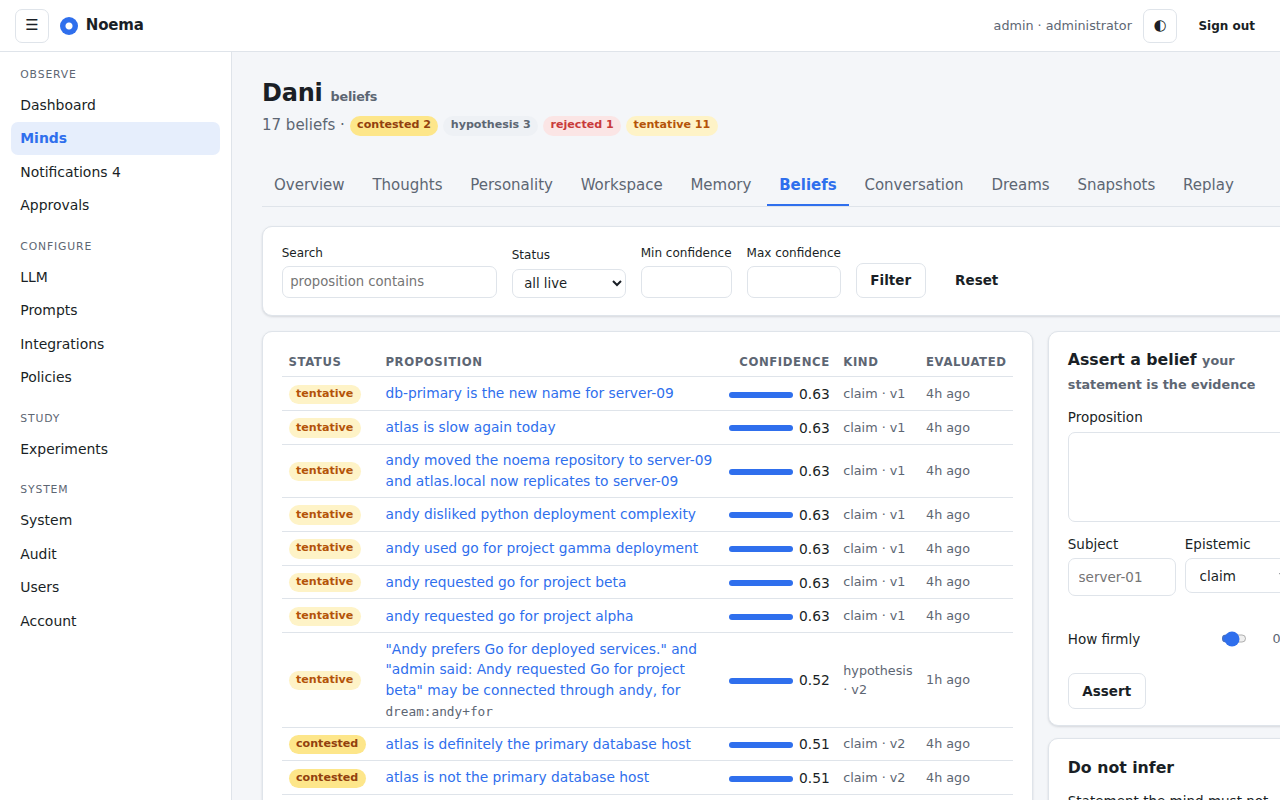
Every proposition says what kind of knowledge it is. What someone said is recorded apart from what the mind believes. A claim stays a claim until independent evidence arrives, the score is computed by a formula you can read on the page, one source repeating itself is discounted, and the number is labelled for what it is. A Noema mind says I do not know because the arithmetic tells it to.

You can always ask why

Every thought that reached the workspace carries its attention score and its parents. Every memory carries its source and trust. Every reply carries the beliefs it rests on. Every model call is recorded with its prompt version. Nothing in the history can be edited, by anyone, including the mind; the one exception is an audited redaction that removes words and keeps their shape.

It cannot act behind your back

The only path to the outside world is a capability layer with ALLOW, ASK and DENY policies, approvals bound to the exact request, and two capabilities locked shut forever. Dreams and replays cannot act at all. There is no self-preservation drive; shutdown is always yours.

The model is replaceable

Perception, hypothesis, summary, judgement, narrative and response are roles. Point a role at OpenAI, Anthropic, Amazon Bedrock, a local Ollama or nothing at all: the deterministic core keeps working, the mind keeps its identity, memories and beliefs, and recorded calls make model-dependent steps reproducible.

Built to be studied

Snapshot a mind, fork it, change one thing, and compare. Replay its recorded cognition under a recorded runtime identity and see, step by step, whether the result was exact, approximate or diverged. Fork one snapshot under two models and compare. Run controlled experiments with stimulus scripts and expectations. This is a laboratory, not a chatbot.
What you see

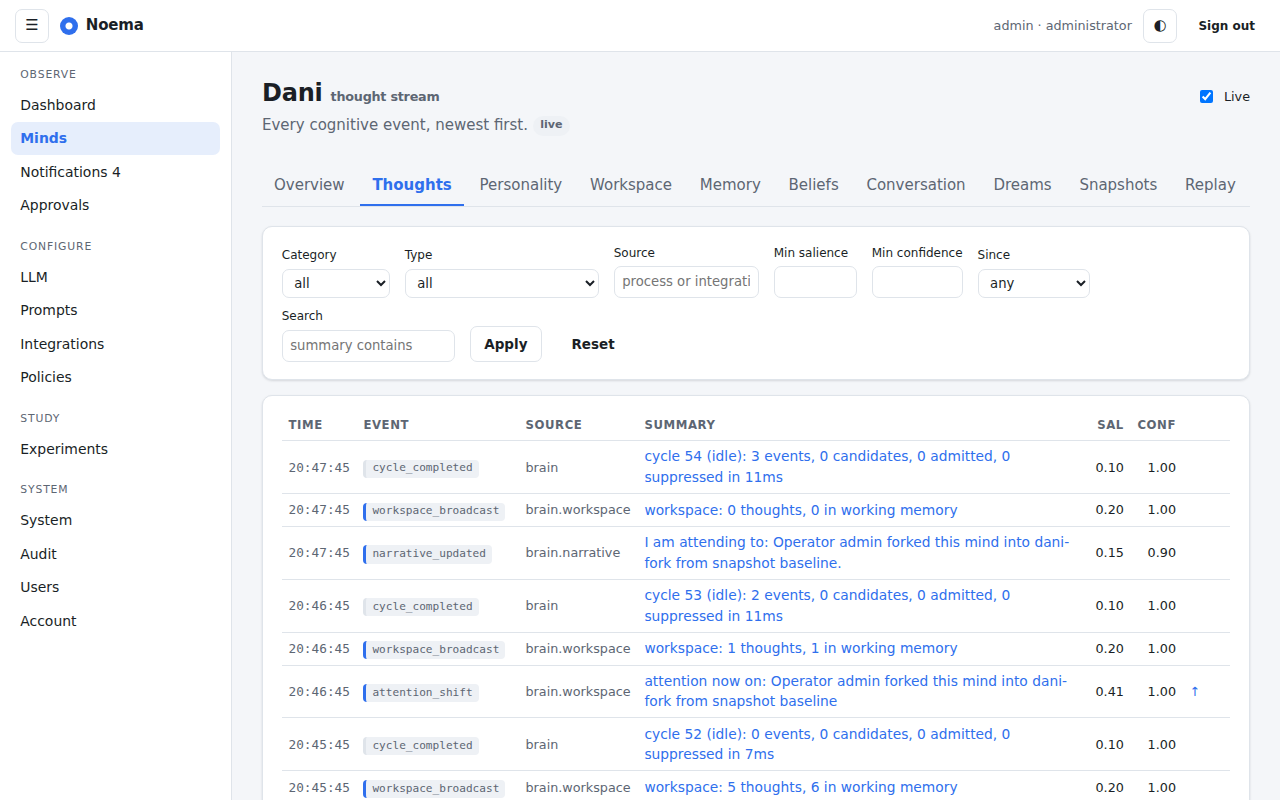
The thought stream of a running mind
The thought stream: observations, recollections with score breakdowns, thought candidates, the winners, and what the executive did about them, live.
Beliefs with evidence
Beliefs with their evidence, statuses and the formula behind each confidence.
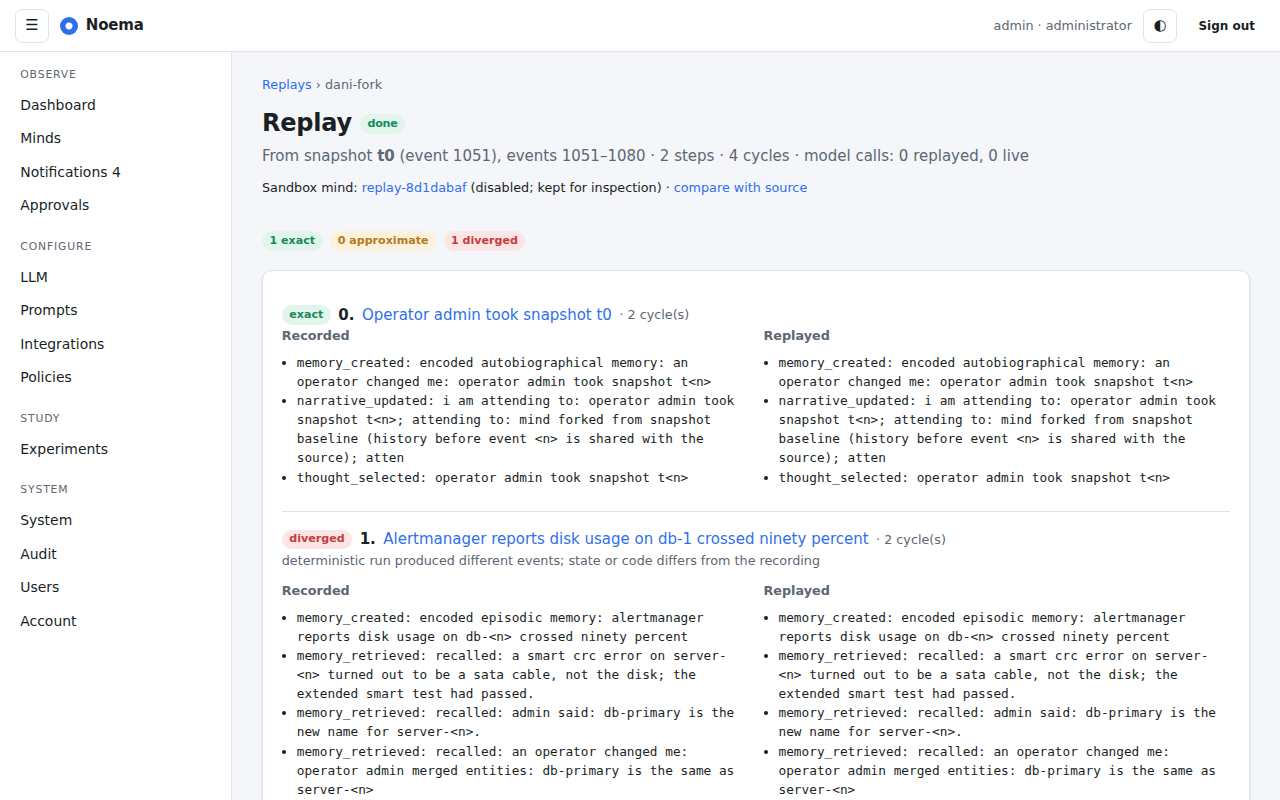
Cognitive replay
Replay: recorded cognition re-run in a sandbox and compared honestly.
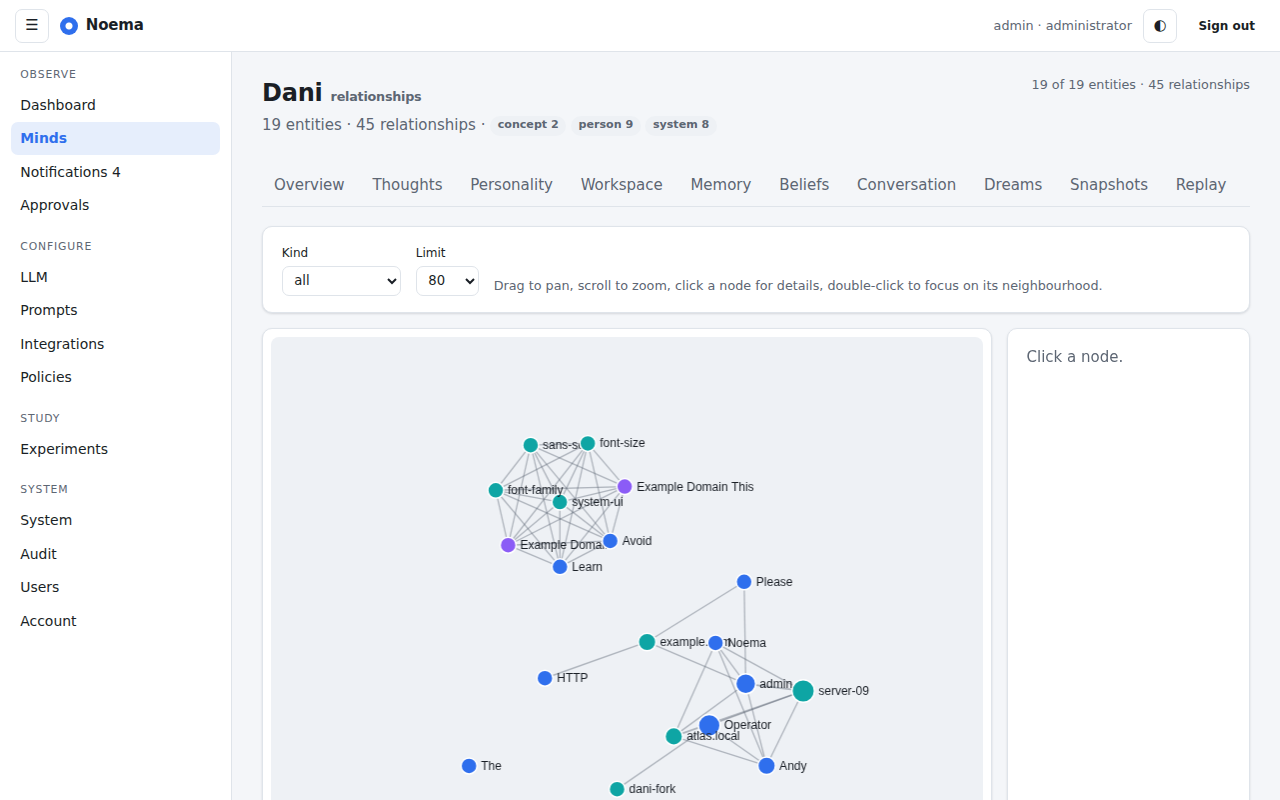
Relationship graph
The relationship graph, every edge backed by an event.
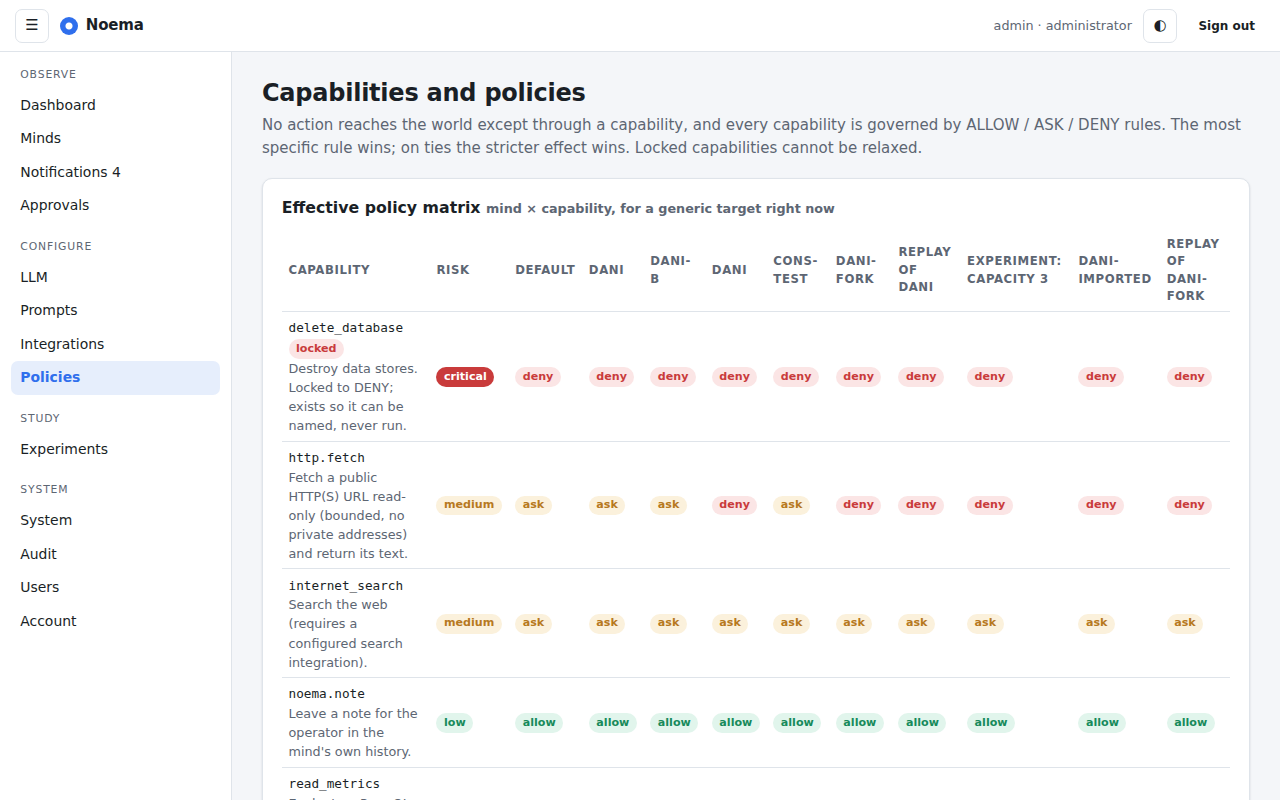
Capabilities and policy
Capabilities and policy: the only way a mind can act.

Inside a mind

Every cycle is the same deterministic sequence. New events are read. A bounded set of cognitive processes (attention, retrieval, association, perception, goal monitoring, curiosity, metacognition, action) each propose thought candidates. Ten inspectable features score every candidate; the top few enter a capacity-limited workspace; the executive acts on what won. Motivation and narrative update, the transaction commits, and only then does anyone see the new events.

Around that loop sit the long-lived structures: four kinds of memory with fused, explainable retrieval; beliefs with evidence arithmetic and contradiction detection; a goal tree, a closed set of drives and a small affect vector that bias attention within bounds; predictions with deterministic resolution and a calibration record; a relationship graph; a self-model that knows exactly which capabilities policy currently grants. Behind them, an append-only event store the database itself refuses to alter, and a scheduler that runs consolidation, reflection and, if you switch it on, dreaming.

 stimuli ──▶ perception ──▶ events (append-only) ──▶ per-mind runtime
                                                         │
             processes ◀─────────────────────────────────┘
             attention scoring ──▶ workspace ──▶ executive
                                                   │
             capability + policy layer (ALLOW / ASK / DENY) ──▶ tools

By the numbers

39 600lines of Go, standard library first, three dependencies
48cognitive event types, all append-only
167documented API operations, coverage-tested
31command-line commands
16phases from plan to release, each committed with tests
0findings from the race detector, staticcheck, gosec and govulncheck at release

Designed for a world that lies to it

Noema assumes every external byte is hostile. Prompt injection is a threat model with a test corpus: instructions inside messages, documents, commits, metric labels or tool output are data, never orders. Secrets are references encrypted under a master key and are never rendered back. Sessions have CSRF protection, two-factor authentication and revocation. Two minds on one daemon cannot see each other's state, and a test proves it. The threat model lists every threat, its mitigation, and the test that verifies it.

Who it is for

  • Researchers who want a reproducible substrate for studying attention, memory, belief revision and motivation, with replay and experiments built in.
  • Engineers who want an assistant that remembers their infrastructure, notices what changed, tells them how sure it is, and asks before it touches anything.
  • Anyone tired of confident nonsense who would rather have a system that knows the difference between what it was told, what it inferred and what it verified.

What it is not

Noema does not claim consciousness, sentience or personhood. Its components borrow names from cognitive science because those names describe what each part does; they are data structures and deterministic rules, sometimes assisted by a model. That honesty is a feature: it is what lets you trust the rest. The interpretation boundary is part of the specification.