The Parish
You are the Steward of a small settlement in a world that never pauses. Close the tab and Embermoor carries on without you: the shops open, the commuters queue for the bridge, the council pays its bills and the local paper writes up whatever happened. Come back a week later and a month has gone by. Things were built, businesses opened and folded, new families moved in, and every bit of it is written down.
It is a city builder for people who like to tend something rather than race it. Draw a plan, commit it, and wait for the builders. The waiting is where the reading happens, and there is a great deal worth reading.
- Browser game
- Persistent world
- City building
- Simulation
- Free to play
What it is:
A persistent, multiplayer town simulation
Plays in:
Any modern browser, desktop or phone, installable as an app
Status:
Live at parish.dixon.cx, free to sign up
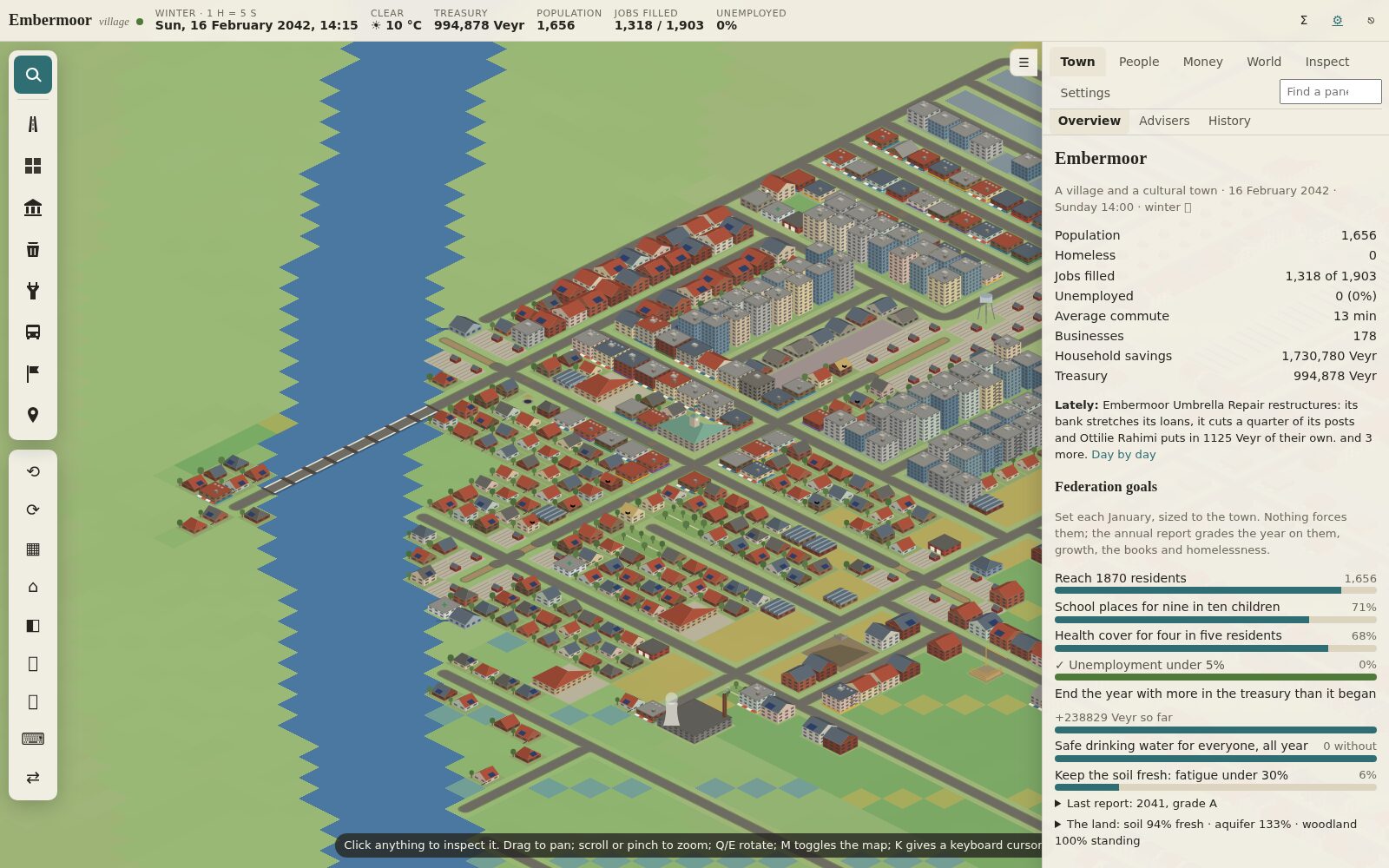
A town that keeps living
The whole world runs on one clock, about an in-game month for every real week, whether anybody is watching or not. Hours run the things that depend on the time of day: power demand, opening hours, wages, shopping. Days run the things that depend on yesterday: demand, development, prices, opinion, fires and crime. Months close the books, years hand out a report card and, every five, an election.
So a session can be ten minutes with the morning digest and a plan, or an hour in the accounts, and both are complete. The town rewards attention but never punishes you for having a life. Nothing that happened while you were away is quietly undone for your convenience, and nothing ever deletes a town: a failed bank or a lost dispute leaves the place and its history standing, with a way back.
Every number has a reason
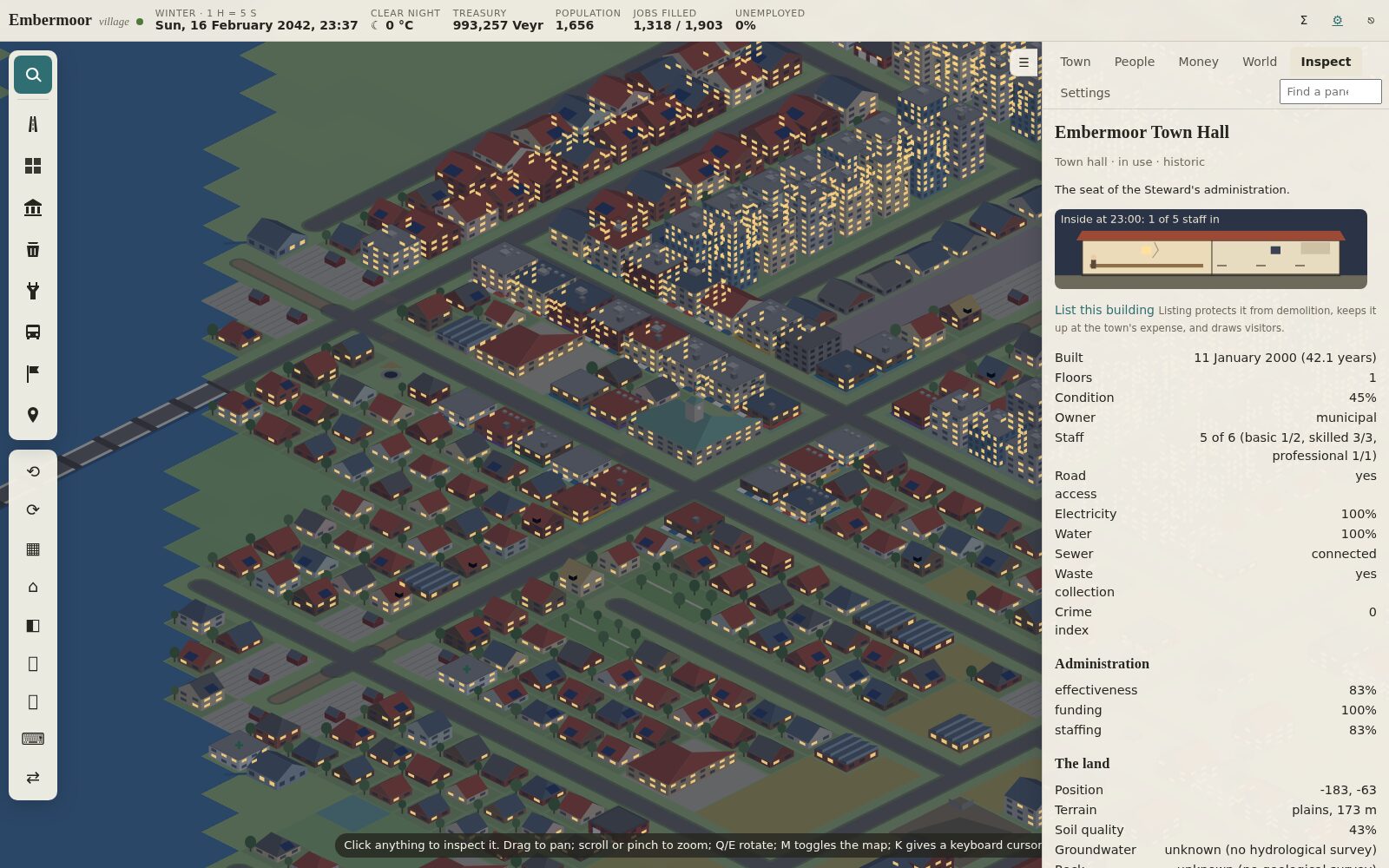
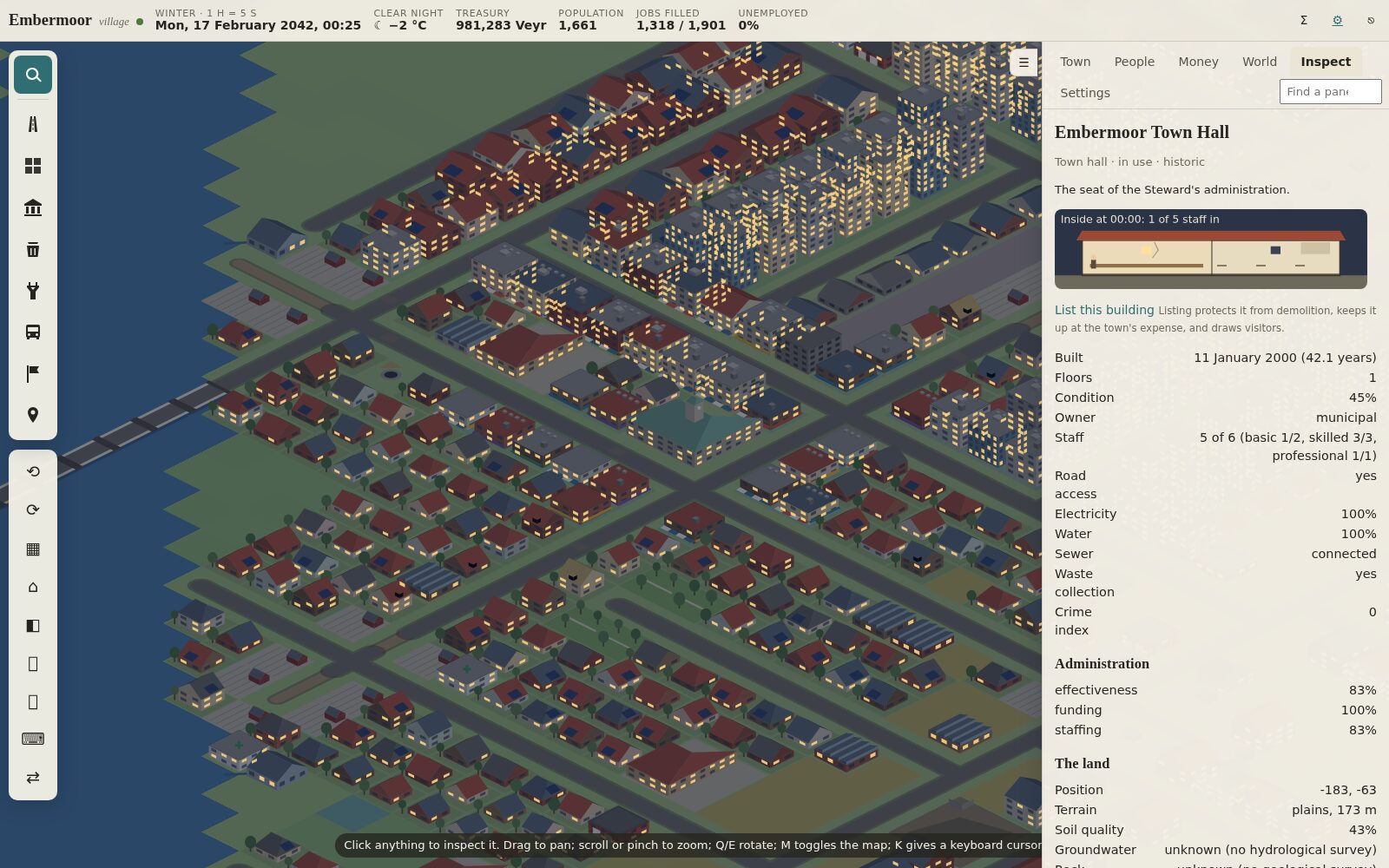
Click anything. A building opens as a cutaway of the inside at the current hour: who is home, who is at their desk, stock on the shelves, lamps lit only where someone is, cracks and damp where the fabric is poor. Businesses are real, named and keep accounts, so when one closes you can read exactly why: a labour shortage, unreliable electricity, taxes, or customers who stopped coming.
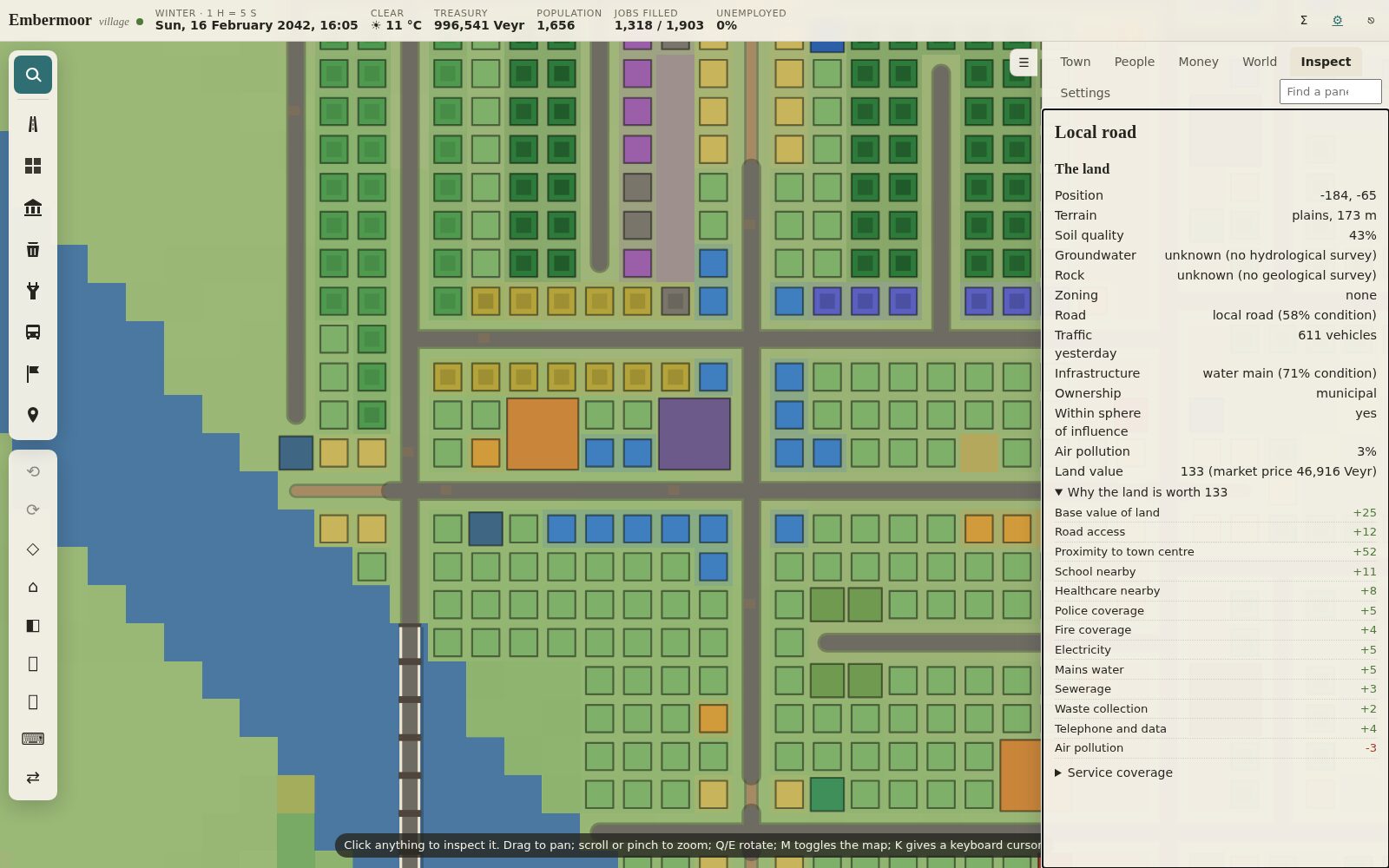
Land value, demand, prices and opinion are each a sum of named factors, and the screen shows the same numbers the simulation used. Why is that plot worth 133? Fifty-two for being near the centre, eleven for the school, eight for the clinic, minus three for the air. The question "why?" always has an answer, and it is always the real one.
Plan, commit, wait
Nothing you draw happens at once. Roads, zones, bridges, bus lines, water mains and power lines all go into a plan that is costed as you work: construction, land to buy, compensation, how many people are displaced, how long it takes and what people will think of it. Commit it, and the builders turn up. If the world moved on while you were planning, say a house went up where your road goes, the plan is re-checked and you fix only the parts that no longer fit.
- Roads that behave like roads: six classes from dirt track to motorway, fords and bridges across rivers, every commute routed, and people choosing to walk, cycle, catch the bus or drive.
- Utilities that can fail: electricity is hourly and peaks in the evening, turbines stop in a calm, rivers carry pollution to the next town's intake and old pipes leak.
- The ground is unknown until you survey it, so dig wells after a hydrological survey and zone mines after a geological one.
- Weather that matters: droughts drain wells, late frosts hit farms, and a regional radar shows what is blowing in from the west.
- Neighbours: other Stewards' towns are joined by roads and railways with yesterday's freight moving along them, and after a disaster their homeless walk in along the same roads.
Money you can follow
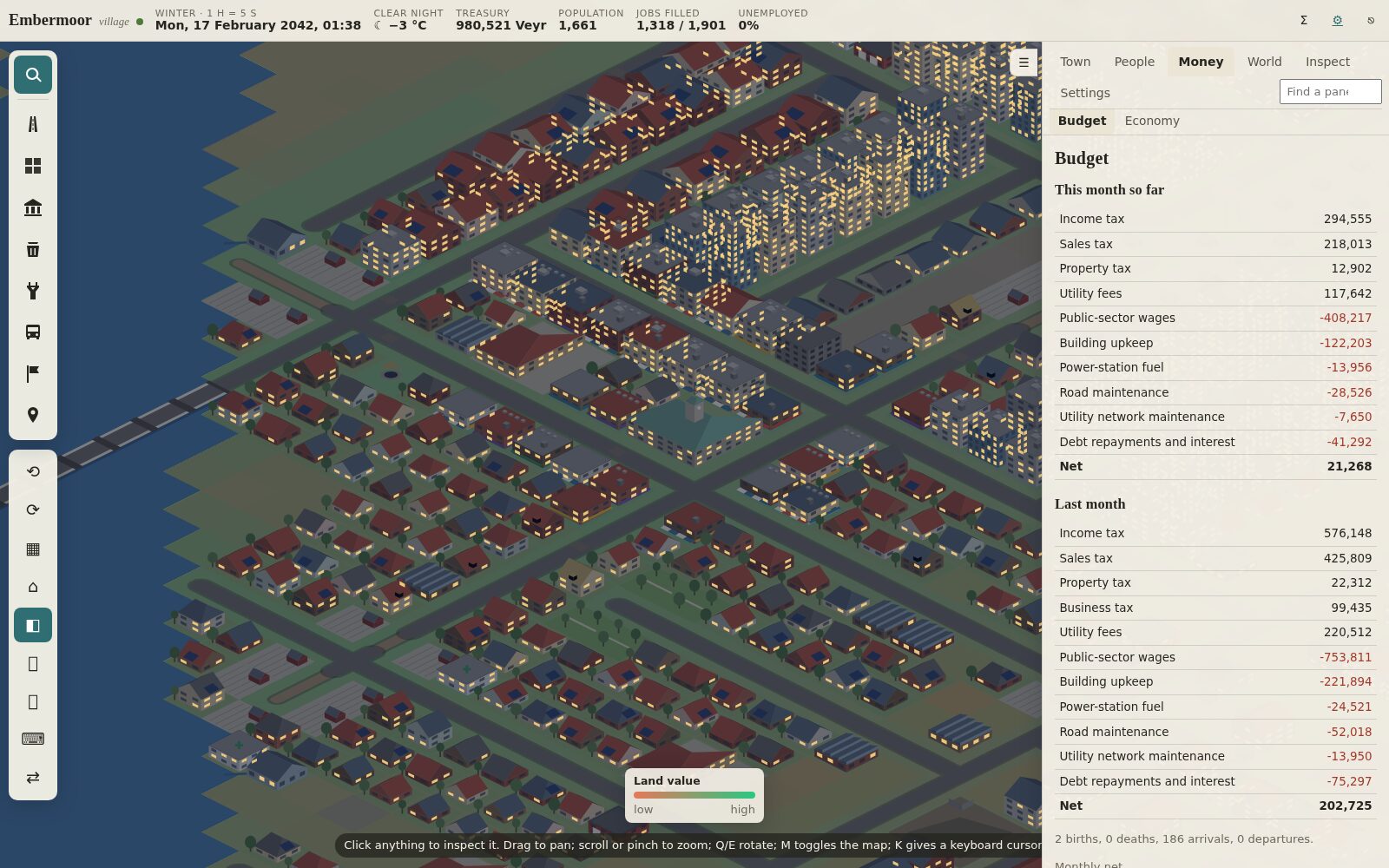
Money is a conserved integer. Every Veyr that enters or leaves a town does so through a named account: wages become spending, spending becomes shop takings, shops buy from local producers before importing, and taxes are a share of that flow rather than a tap. There is no hidden dial. If the game ever helped you, you would see it on the books, which is why it doesn't cheat.
People with opinions
Opinion is not one number. Families, young workers, retirees, business owners and farmers each want different things, and an unhappy group protests, pays less tax and eventually leaves. Their loudest grievance appears in the local paper as a letter in their own name, and you get to reply, once a week, in three hundred characters. Ignore them long enough and they field a candidate at the next election, and if they win, the council's priorities are theirs for five years.
Crises arrive as decisions with costed options and a deadline: bail out the big employer or retrain its staff, concede to striking clerks or hold out, sandbag the waterside or evacuate it. Miss the deadline and the choice is made for you, and the Chronicle records what came of it. At the far end there is a spaceport, if your town reaches twenty-five thousand people and the research department keeps up.
Under the bonnet
- Deterministic: the same seed and the same actions give the same town. Randomness is hashed from the step and the subsystem, so a snapshot is the whole state and a replay is a proof. That is what makes time-lapses, restores and a hundred-year soak test possible.
- One Go server, PostgreSQL and PostGIS: an effectively infinite, procedurally generated world, streamed to a plain JavaScript client that draws the isometric view, the flat atlas and every building by hand.
- Accessible by design: a keyboard cursor announces every tile to a screen reader, and the whole game can be played without a mouse.
- Your town is yours: download everything the game holds about it as one JSON file, or print the Book of your town, a year-by-year history with its grades, disasters, elections and the buildings it kept.
Found your town
The Parish is free. Sign up, name your civilisation and say where you would like to begin: by a river, on the coast, on fertile plains, near minerals, somewhere remote or next to other players. The surveyors find a real place that suits, and you inherit a hamlet with a town hall, a crossroads, a few cottages, shops, workshops, farms and an old well. What it becomes is up to you, and it will still be there tomorrow.