14. Exit planning and contingency thinking

The short version
- Exit planning is quiet housekeeping, not drama. The aim is fewer things that can trap you, not predicting the future.
- Untangle your chains. Email and phone number sit at the centre of everything; make sure no single one can lock you out of your life.
- Paperwork and money break plans more often than technology. Know where your documents are and have a backup way to pay.
- Stay legal, documented and boring. Selective separation works; trying to vanish does not.
Exit planning is making sure you can change your routine, location or digital footprint without panic if things shift. No brinkmanship required.
It is not only for extreme situations. A job ending unexpectedly, a relationship becoming unsafe, a service provider failing: all count. You are not trying to predict the future, just to reduce the number of things that can trap you in the present.
Preparing quietly
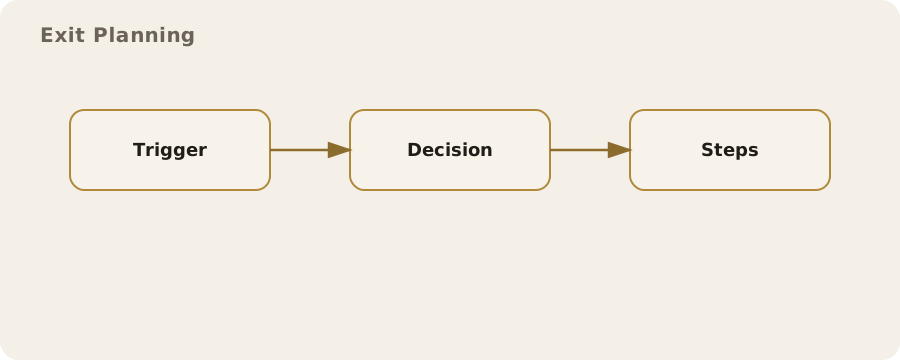
Quiet preparation means building options without announcements or new dependencies.
Change every setting, close every account and move every file in one weekend, and you create obvious patterns and a high risk of mistakes. Small, consistent changes that blend into daily life are far more sustainable.
What that looks like:
- A spare phone not linked to your main number: buy it as part of a normal upgrade cycle and keep it in a drawer until needed.
- Documents leaving a cloud service: move them as ordinary housekeeping, not a dramatic purge.
Slower, yes. But far less likely to draw attention or leave gaps.
Escalation signals
Escalation signals are the practical signs a situation is getting riskier, not the dramatic headlines. They come in three flavours:
- Personal: a pattern of harassment, repeated attempts to get into your accounts.
- Organisational: a policy change that expands data retention.
- Systemic: new legislation or policing practices that change what counts as routine.
The point is to notice when your current assumptions no longer fit.
Often the signals are mundane:
- Your employer suddenly wants a monitoring app on your personal phone. That tells you about future expectations.
- A landlord starts asking for unusual documentation. That tells you how your information is being handled.
- A service starts asking for a selfie or biometric scan to unlock your account. A decision has been made to tie your identity to one provider's judgement.
It is easy to dismiss signals as paranoia, and just as easy to ignore them out of habit. The middle path: collect evidence and decide whether the signal changes your risk.
In the UK, a shift in how agencies share data, or a new age verification requirement for online services, might be enough to rethink where you keep sensitive accounts. You do not need to react immediately. You do need to recognise the ground may be moving.
Reducing digital drag
Digital drag is the hidden cost of leaving everything tied together: logins, subscriptions and device links that make any change harder than it should be. Convenient, until you need to move or shut down quickly.
Start by mapping the chains:
- Your email account usually sits at the centre, resetting passwords and confirming new devices.
- Your phone number sits beside it, receiving SMS codes and handling account recovery.
Lose or compromise either and large parts of your life can lock up. You do not need to abandon these tools; just reduce how much depends on any single one.
- Use a password manager for unique logins, so accounts can be disentangled.
- Add a second recovery method where possible, such as a hardware security key or a secondary email address that is not widely known.
Myth: deleting the app severs the connection. Reality: many services keep collecting data and keep access after the app is gone. To genuinely reduce drag, review account permissions and revoke tokens: visit each account's security page and remove old devices, or unpair apps from platforms like Google or Apple. Tedious, but it is the difference between a superficial clean-up and actually being able to move on.
Social logins are another source of drag. If everything relies on one social platform, one suspension or policy change can break a dozen services at once. Gradually replace "log in with" buttons with direct accounts, starting with the services you would struggle to lose. Then stepping away from a platform does not bring the rest down with it.
Financial and document readiness
Exit plans often fail not because of technology but because of paperwork and money. A sudden move is far easier if you can prove who you are and pay for essentials without relying on one app or bank account.
In the UK that usually means having:
- access to basic identity documents;
- a reliable way to pay;
- a plan for receiving income or benefits if your usual systems change.
Document readiness is knowing what you have, where it is and how fast you can get it, not carrying everything everywhere.
- Keep a list of document numbers and issue dates somewhere secure, so a lost passport can be reported quickly.
- If you have the legal right, keep certified copies of key documents, stored separately from the originals.
This is not about evasion. It is resilience for when documents are stolen, damaged or delayed.
Financial readiness is not hoarding cash. Cash has a role, but limits: it can be lost, it is awkward for rent or online purchases, and large withdrawals can raise questions at a bank. A balanced setup might be:
- a small amount of cash for immediate expenses;
- a secondary account at a different bank, with a modest balance;
- knowing how to reach your funds if your main account is frozen or inaccessible, including logging in without relying solely on a phone number.
The trade-offs are real. Split accounts mean more admin and possibly fees. Copies of documents increase exposure if mishandled. All manageable with care: secure storage, as few people with access as possible, and a periodic review rather than letting it sprawl.
Data abandonment
Data abandonment is deciding to leave some digital material behind. It can be deliberate (not migrating years of email archives) or forced (losing access to an old account).
Myth: abandoning data is always a failure. Reality: sometimes it is the safest or most practical choice.
- Leaving a job: you could download everything from your employer's cloud storage, but that might include confidential material you are not allowed to keep. Leaving it is not only legal, it is responsible.
- An old social media account that has become an unwanted link to your past: you might delete it and accept losing the content and contacts rather than exporting everything.
The risks: losing something you later need, or leaving behind access that could be exploited. The fix is a conscious choice about what to keep and what to let go.
- Keeping data? Export it in a format you can read later and store it securely.
- Abandoning an account? Remove personal information, revoke connections, and note what you closed so nothing surprises you later.
Some services keep data after deletion for legal or operational reasons; in the UK they may do so for legitimate interests or regulatory obligations. You cannot always erase everything, but you can reduce what is actively tied to your identity.
Rebuilding elsewhere
Rebuilding is setting up a workable life in a new digital environment, not achieving perfect anonymity. Usually that means a fresh email address, new logins and a smaller, more controlled footprint. The trap is recreating the same dependencies you were trying to escape.
Start with the essentials: communications, banking and housing. Say you move to a new city and take a temporary role while you stabilise. You might:
- set up a new email address used only for official accounts;
- keep personal contacts on a separate address;
- avoid linking the two through a single phone number;
- decide some services do not need your real name, while others legally do.
That last distinction matters. It is a normal part of living within UK rules without exposing your identity to every platform you use.
There is a practical limit to compartmentalising. Employers, landlords and government services often need consistent identity checks. An entirely separate identity for everything is likely to fail and may have legal consequences. What works is selective separation: isolate sensitive or high-risk activities, and let ordinary, lawful activities be tied to your real identity as required.
Fresh starts bring new risks, mostly forgotten security steps like two-factor authentication or updated recovery details. Make setup a routine. Every new account: add it to your password manager, enable a second factor, note the recovery methods somewhere secure. Small habits, much less fragile.
Safety-first exit planning (lawful relocation and privacy)
Some people need to change routine, location or digital exposure for safety reasons. This section covers lawful, safety-first exit planning: reducing exposure, preparing documents, and relocating or changing details within the rules. It is not about evasion, fraud or trying to erase yourself from society. Keep your actions legal, documented and boring.
First, define the risk. Are you trying to:
- reduce harassment?
- break a pattern of stalking?
- leave a coercive environment?
Each changes what "safe" looks like and which protections exist. In the UK that may mean local safeguarding services, domestic abuse support organisations or advice from a solicitor. A clear picture early saves you from high-effort changes that do not reduce the specific risk you face.
Keep privacy measures and identity changes separate.
- Privacy measures: tightening social media visibility, removing public address details, cutting down the services that publish your data.
- Identity changes: legal processes such as changing your name by deed poll, updating electoral roll settings, or requesting that records be suppressed where the law allows.
Mixing them without a plan creates confusion and inconsistent records that are harder to manage later.
Build a documentation pack that supports lawful changes: proof of identity, proof of address, and evidence for any risk-based applications. Keep a minimal list of where each document is, which numbers go with it, and how to replace it if lost.
Changing address? Redirect mail through official services, then update a short, prioritised list of critical accounts first:
- banking;
- GP;
- DVLA;
- HMRC;
- employer;
- utilities.
The goal is fewer loose ends, not hidden ones.
Reduce public data exposure systematically. Many data brokers and people-search sites work on opt-out or removal requests. Slow and imperfect, but it meaningfully reduces how findable you are. Start with sites showing address history and phone numbers, then work outwards.
At the same time, tighten the sources feeding those listings: social media, electoral register settings, professional directories, and company registrations where you can legally choose what is published. Not instant, but the cumulative effect is real.
Plan the move so it does not create new holes. Temporary accommodation can delay disclosing a long-term address, but shared networks or devices can open security gaps.
- Use a dedicated email address for official updates.
- Keep separate contact channels for friends and for institutions.
- Do not broadcast location changes on public profiles.
- Need a new phone number? Transition gradually rather than switching overnight, so you do not lock yourself out of recovery flows.
Financial continuity matters more than secrecy. Make sure you can pay rent, get your wages and pass identity checks without relying on one app or device. A backup payment method and a second contact route stop you being stranded.
Leaving a hostile or unsafe environment? Talk to a support organisation about safe banking, benefits eligibility and emergency grants. They can often point you to options that are lawful and practical, rather than improvised and risky.
Finally, set expectations. You cannot erase all traces of yourself, and you should not try. Aim to reduce exposure to a level that makes life safer and more stable, while staying inside the law and keeping access to housing, healthcare and work. Treat it as a programme of practical steps, not a dramatic disappearance. Quiet and well documented usually wins.
Do this now
- Write down which email address and phone number your most important accounts recover through. That is your chain map.
- Add a second recovery method to your main email account.
- Open one account's security page and remove any devices or connected apps you no longer use.
- Note where your passport and other key documents are, with their numbers and issue dates, somewhere secure.